

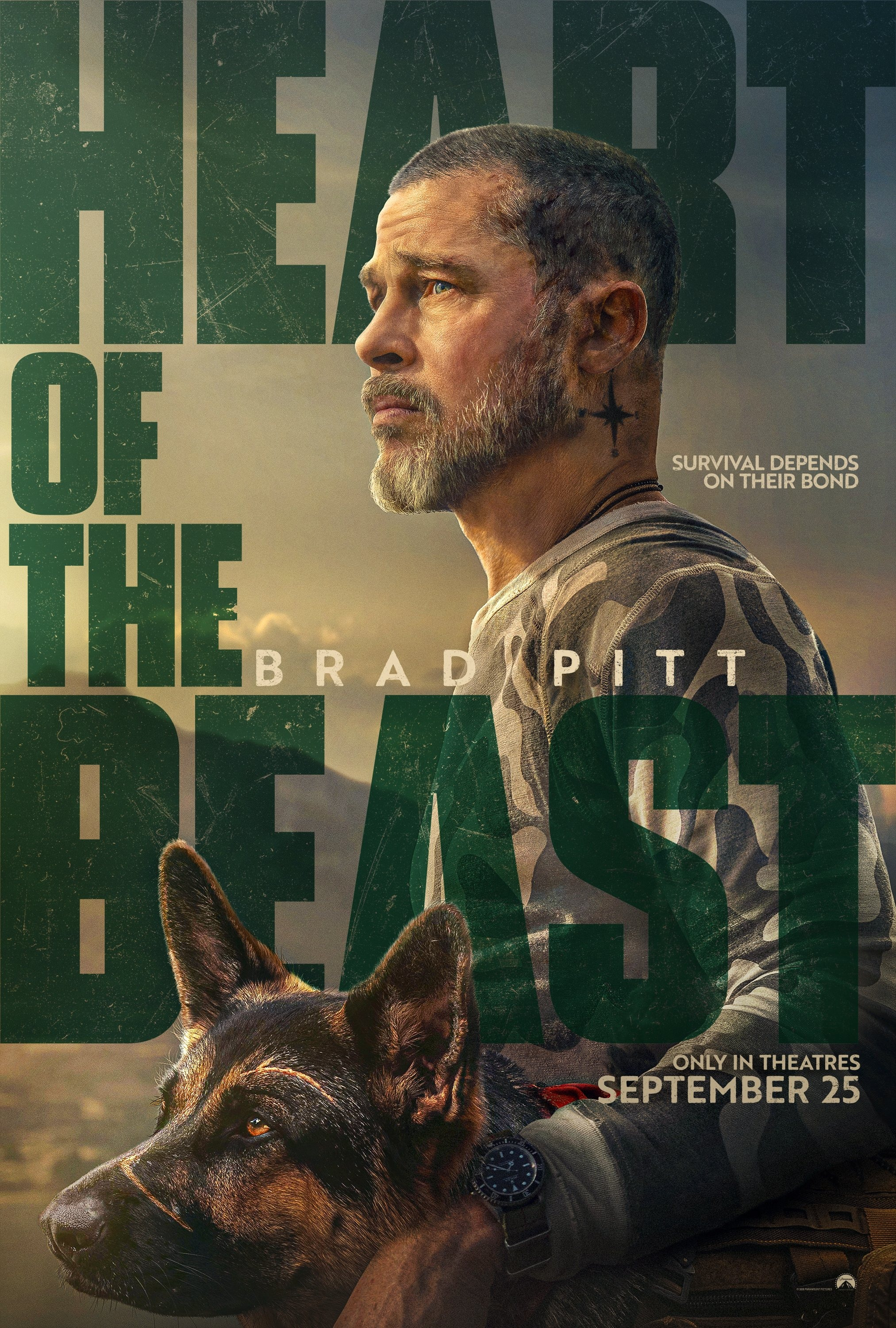

Director David Ayer’s Heart of the Beast tells a simple but beautiful tale about suffering, survival, and the nobility of man’s best friend. Employing mostly quiet moments and the beauty of the wilderness, Ayer shows us two old war dogs, one human, one canine, doing their best to find peace, only to be confronted by a final battle. The depths of their friendship and the things they will endure for each other give Heart of the Beast a moving and unpretentious character. It’s a wholesome, simple story.
Retired Army Special Forces veteran James Belmont (Brad Pitt) and his war dog, Odin, fly to a remote corner of Alaska to find a few weeks’ peace. Both suffer from lingering physical and mental wounds that can’t really be explained to an outsider. There’s a sublime quiet to the place. The looks and gestures that pass between Belmont and Odin testify to hard living and mutual respect that echoes the isolated beauty of the surrounding landscape. There’s a poetry to the unhurried, methodical way that Belmont unpacks his plane, sets up camp, builds a fire, and roasts newly caught fish over it. He and the dog are at home here. Their resources may be scarce, but they have everything they need.
Small things tell us that Belmont and Odin, though not bitter about their service, are done with war forever. Belmont carries a gun but now only uses it to sight songbirds, which he records in his nature journal. The dog has a seriousness to his gaze that suggests long years of alertness, and he wakes up whimpering, remembering a battle still playing out in his mind. When they encounter another outdoorsman named Watkins (J. K. Simmons), Belmont’s careful reticence tells the viewer something about what war has done to his capacity to extend trust. Only the dog’s tolerance toward Watkins and the latter’s evident harmlessness manage to warm Belmont’s iceberg exterior. After warning Belmont about a coming storm, Watkins paddles off in the early morning mist, like a benevolent spirit, leaving Belmont with a book whose underlined passage might serve as a gentle correction to the latter’s insularity:
He had survived the worst the world could throw at him. He had known the cruelty of men, but he had survived. And love for man had taken root in his heart.
Jack London, White Fang, 1906.
Disaster strikes shortly after. As the trailer already reveals, Belmont’s plane goes down. I won’t spoil any of the details of the ensuing struggle except to say that the man and his dog must now brave progressively complicated natural threats as they attempt a fifty-eight-mile trek toward a road that may or may not increase their chances of finally being rescued. Neither man nor dog complain. This is a story of doing all that one can do with what one has been given. Even when life is approached this way, human success is not guaranteed, though virtue and true friendship are their own kind of success. Without spoilers, I can say that the struggle isn’t pointless. The film has a happy conclusion, a meaningful end, but perhaps not a Hollywood ending.
Heart of the Beast is not a sophisticated movie, but it is beautiful. It has few characters and relatively sparse dialogue. Belmont and Odin’s world is equal parts wonderful and dangerous, sometimes unfair, and sometimes strange. It’s a good world for all that, because it’s a place where real friendship can exist, even between a man and a beast. It’s also a strange world, because friendship seemingly requires some kind of real intellectual parity. But what do men and dogs have in common that could serve as a basis for friendship? The answer must have something to do with the heart and with love’s mysterious capacity to exalt the lowly.
Heart of the Beast is a very wholesome movie, and could easily have been rated PG if not for Belmont’s occasional and regrettable use of “G*d**mn.” Film aficionados should be warned that a few of the CGI wild animals do not look real, and that the war flashbacks weren’t actually necessary to tell the story. The film would have been a little more powerful if Ayer trusted the viewer to deduce Belmont and Odin’s backstory from the wounds they still carry. In my view, these flashbacks detract somewhat from Belmont’s big character moment at the end by showing us what was—in this rare case—better told, and solely by him. Aside from these small imperfections, and with caveats about the language, I highly recommend Heart of the Beast.